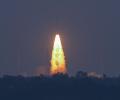
A PSLV rocket carrying Earth observation satellite EOS-09 failed to launch from the Sriharikota spaceport early on Sunday.
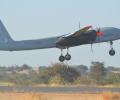
Rustom 2 is being developed on the lines of predator drones of the United States to carry out surveillance and reconnaissance roles for the armed forces with an endurance of 24 hours, officials said.

The PSInSAR satellite technique used to observe the gradual sinking of Uttarakhand's Joshimath town is a powerful remote sensing tool capable of measuring and monitoring displacements in the Earth's surface over time.

The RISAT-2B would replace the RISAT-2, which has been actively used by India to monitor activities in camps across the border in Pakistan to thwart infiltration bids by terrorists.

After sending missions to the Moon and Mars, ISRO is now readying a spacecraft to orbit Venus to study what lies below the surface of the hottest planet in the solar system and also unravel the mysteries under the sulfuric acid clouds enveloping it.

'Techfest', an annual science and technology event organised by the Indian Institute of Technology Bombay in Mumbai.

India and the United States, after sending their own respective spacecraft into Mars' orbit, have now agreed to cooperate on future explorations of the Red Planet, which America said will yield "tangible benefits" to both the countries and the world at large.

ISRO chairman S Somanath said the success gave the space agency "greater confidence," as the GSLV will be next deployed in the NISAR mission, a collaborative effort with the US' NASA.

Ahead of his India visit on February 24-25, Trump said that India has not treated his country 'very well' on the trade front and indicated that a 'very big' bilateral deal with New Delhi may not be signed before the American presidential election in November.

United States space agency NASA said it would launch a water-related satellite in collaboration with India's ISRO.

'With India's growing capabilities in the space sector, this creates promising opportunities for enhanced collaboration and market access.'

Around 23 minutes after lift-off, the primary satellite got separated and it was followed by six other co-passenger satellites, which were deployed into the intended orbits sequentially, ISRO said.

Out of its 47 operational satellites, India currently has six to eight satellites which are used entirely for military purposes.
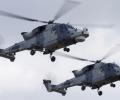
The Indian Air Force is probing the incident, an IAF source said.

If all goes on well, the NISAR satellite will be launched in 2021 from India using the Geo-synchronous Satellite Launch Vehicle (GSLV).

To bolster its arsenal amid recurring incidents of incursions by Chinese troops, India has sought the latest versions of unmanned aerial vehicles -- both the armed and surveillance -- from the United States.

'The impact of merely innocent clouding on radar waves is not expected to be significant on air defence radars of either country to affect operational profiles in modern day context. '
.jpg)
The eternal question remains unanswered, what price security and what cost liberty, says Vikram Sood.

In the years to come, India's space assets will play a much bigger role if and when hostilities break out on our borders, says Pallava Bagla.

UAVs are an intrinsic part of today's technology driven battlefield. Indians don't seem to be taking the challenge with the degree of urgency that is required, says Brigadier S K Chatterji (retd).

Moving ahead with their new mantra -- Chalein Saath Saath: Forward Together We Go -- Prime Minister Narendra Modi and United States President Barack Obama on Tuesday vowed to deepen cooperation in every sector for the benefit of global stability and people's livelihoods over the next ten years.

This is the joint statement issued by the ministry of external affairs on the visit of US President Barack Obama to India.
